
When it comes to serious guitar education, few books match the depth, structure, and reputation of William Leavitt’s Modern Method for Guitar. Commonly referred to as the Berklee Guitar Method, this book has become a benchmark for professional guitar instruction, used as the core curriculum at Berklee College of Music.
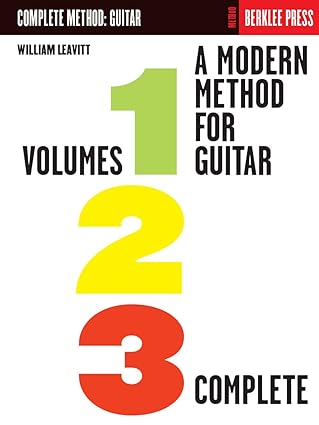
Written by William Leavitt—former chair of Berklee’s guitar department—this method is a staple resource for anyone looking to develop proper technique, music theory understanding, and sight-reading ability. Whether you’re a beginner with basic reading skills or an experienced player looking to solidify your fundamentals, this is a long-term investment in your musicianship.
What Makes the Modern Method for Guitar So Effective?
- Structured Learning Path
The method begins with the essentials—open-position notes and rhythms—and gradually moves into advanced fingerings, positional scales, and key changes. It offers a natural progression that ensures steady technical and theoretical growth.
- Musical and Functional Exercises
Each exercise is written like a short etude, allowing learners to develop skills in real musical contexts. From scale application to rhythmic phrasing and articulation, the method ensures students build a well-rounded foundation.
- Comprehensive Scope
With three volumes totaling over 360 pages, this method provides material that can span years of study. It’s designed not just to teach concepts but to deepen mastery over time—making it an enduring reference for revisiting topics like technique, theory, and reading.
- Sight-Reading Focus
A distinguishing feature of the Leavitt method is its complete absence of tablature. Instead, it emphasizes reading traditional notation. This focus enhances rhythmic accuracy, theoretical understanding, and the ability to communicate with other musicians across genres.
A Trusted Curriculum, Straight from Berklee
The Modern Method for Guitar is not just a book—it’s a curriculum trusted by one of the world’s leading contemporary music schools. The same structured approach used in Berklee’s classrooms is now available to self-learners worldwide.
To enhance the experience, many students choose to pair the book with video instruction from Berklee faculty, such as Larry Baione, a former chair and a student of Leavitt himself. These professional videos offer added clarity, context, and pacing guidance.
Recommended Approach to Studying the Method
The three-volume set can be tackled one book at a time or as a complete curriculum. Each volume builds upon the previous one in difficulty and content complexity. Learners can proceed linearly or revisit sections for reinforcement.
Volume 1: Focuses on open-position reading, basic rhythms, and foundational finger exercises.
Volume 2: Introduces shifting, advanced positions, new keys, and more complex rhythmic notation.
Volume 3: Expands on improvisation, advanced reading, and technical studies used in professional-level performance.
There’s no expectation to finish it quickly. In fact, working through the exercises slowly and thoroughly yields the best long-term results. Each lesson is designed to build cumulative skill and confidence.
Built for Long-Term Technical Growth
Although the method leans toward classical and jazz sensibilities, its core focus on reading, finger strength, and musicality applies to any genre—from rock to blues to contemporary fingerstyle. Players in all styles benefit from the increased musical awareness and technical proficiency it builds.
Whether developing alternate picking, legato phrasing, dynamic control, or fretboard fluency, the Modern Method for Guitar serves as a complete technical and musical workout.
Final Word from Music Samurai
At Music Samurai, we believe long-term development beats shortcuts. William Leavitt’s Modern Method for Guitar exemplifies that ethos. Its professional structure and rigorous content make it a top-tier learning resource—ideal for guitarists who want to elevate their skills seriously and sustainably.